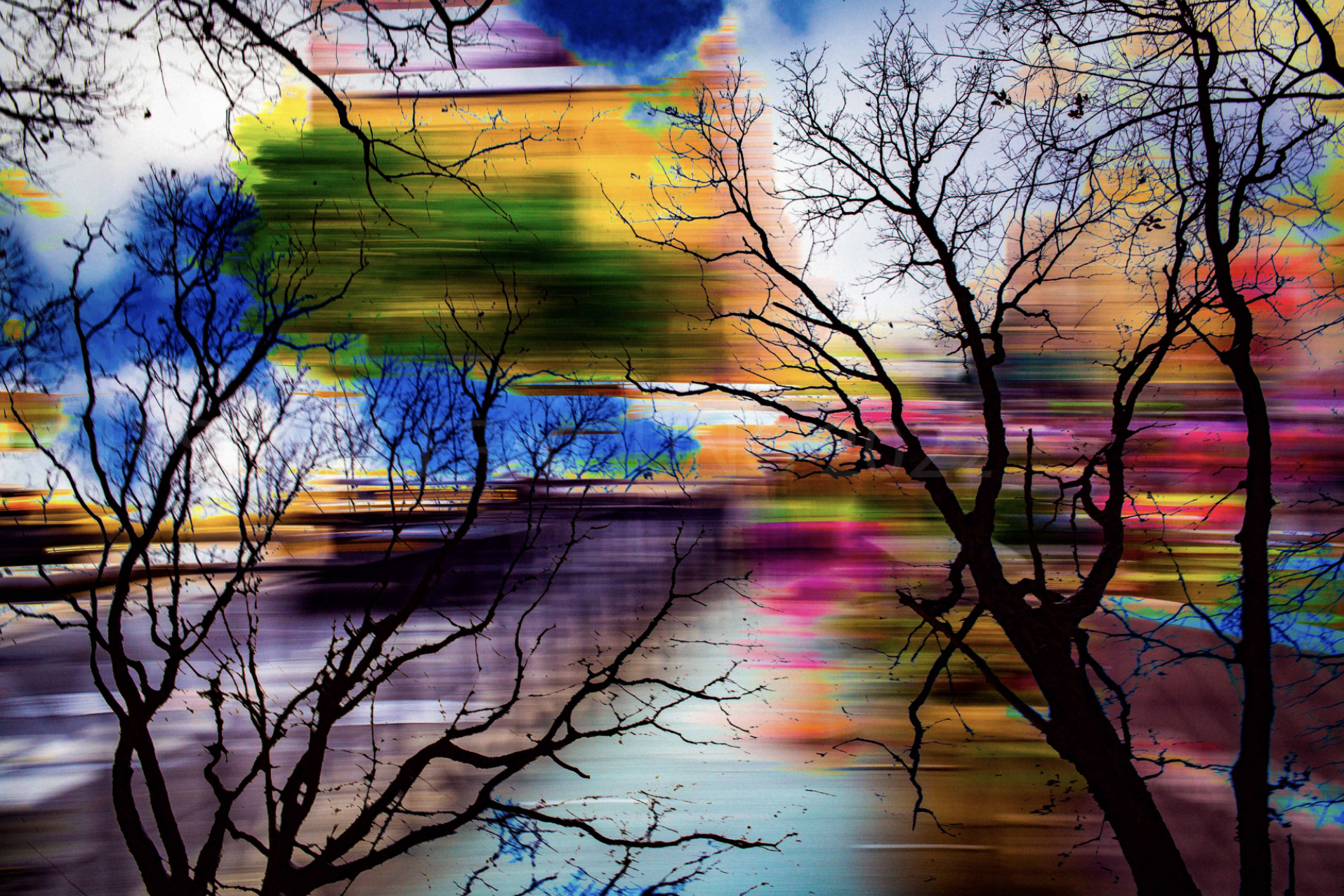

Imaginary Time #2, 2013
Photograph
Chromogenic print (image composed in-camera)
47h x 68w in. (119.38h x 172.72w cm.)
Photograph
Chromogenic print (image composed in-camera)
47h x 68w in. (119.38h x 172.72w cm.)
Urban and rural environments blend together in this time and location-shifted single photograph. By creating individual works across time and space, each piece alters the standard practice of photographing a decisive moment, in favor of capturing spans of time and geographic locations, in this case, multiple U.S. states. Interrogating the perceptual divide between the organic and traces of the constructed urban environment, Imaginary Time #2, dismantles the fixed coordinates of place and time in favor of a layered fluid reality, an evolving temporal and spatial field.
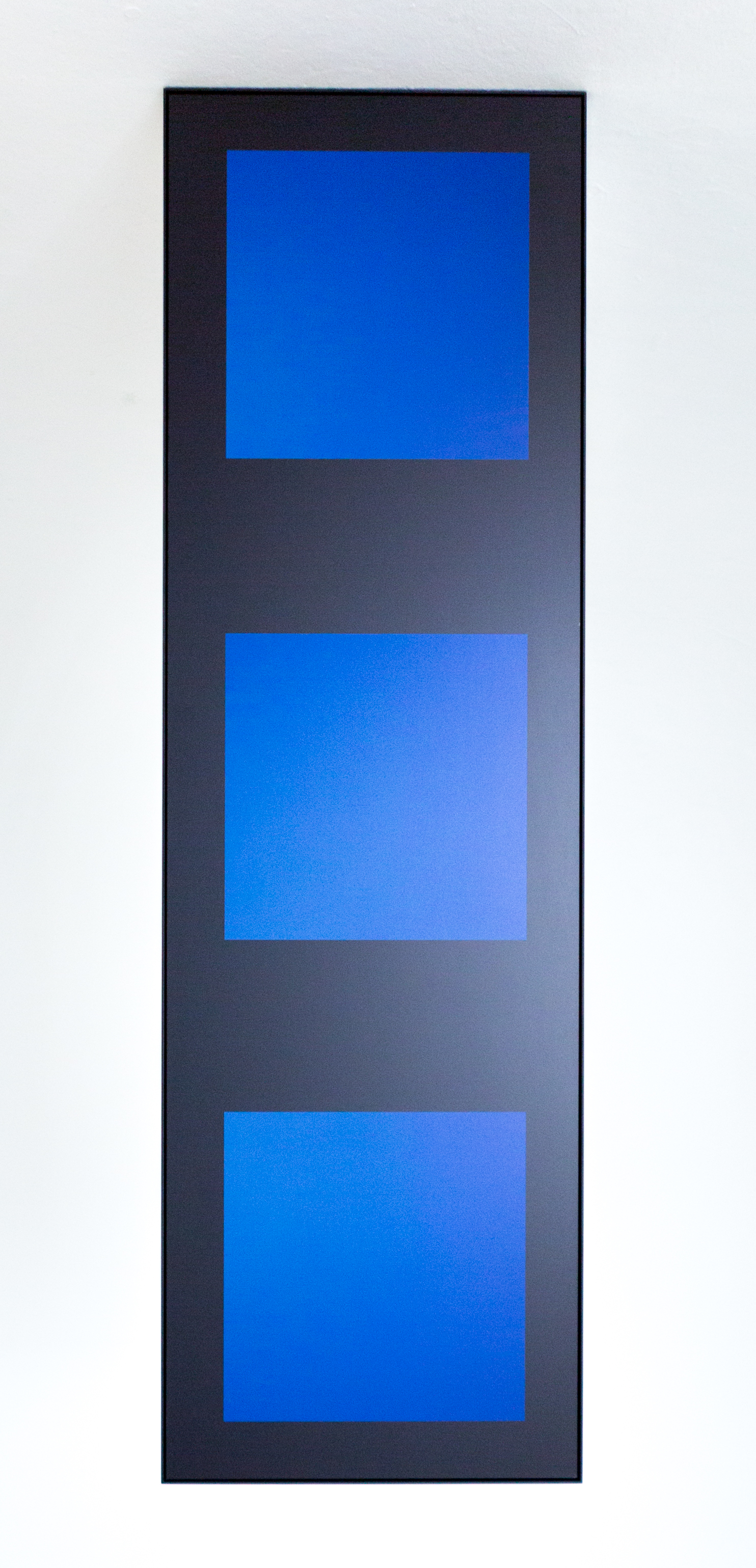

Endurance, 2014
Wall sculpture: LightJet Ilfochrome on Dibond, matte laminate, welded aluminum frame
20 × 64 in (50.8 × 162.6 cm
Endurance, 2014 is three consecutive medium format transparencies of Lower Manhattan azure sky, taken on the same day, arranged in series. This work is meant to be installed on a ceiling, or leaned diagonally against a wall. It may also be hung horizontally or vertically on a wall. The work carries a recurring motif of azure sky which is a loose reference to that searing unforgettable hue on 9/11, and a reference to the indexical image in this era of the digital sensor. Built as an architectural object which provides windows out of darkness, the work also resembles a motion picture filmstrip.

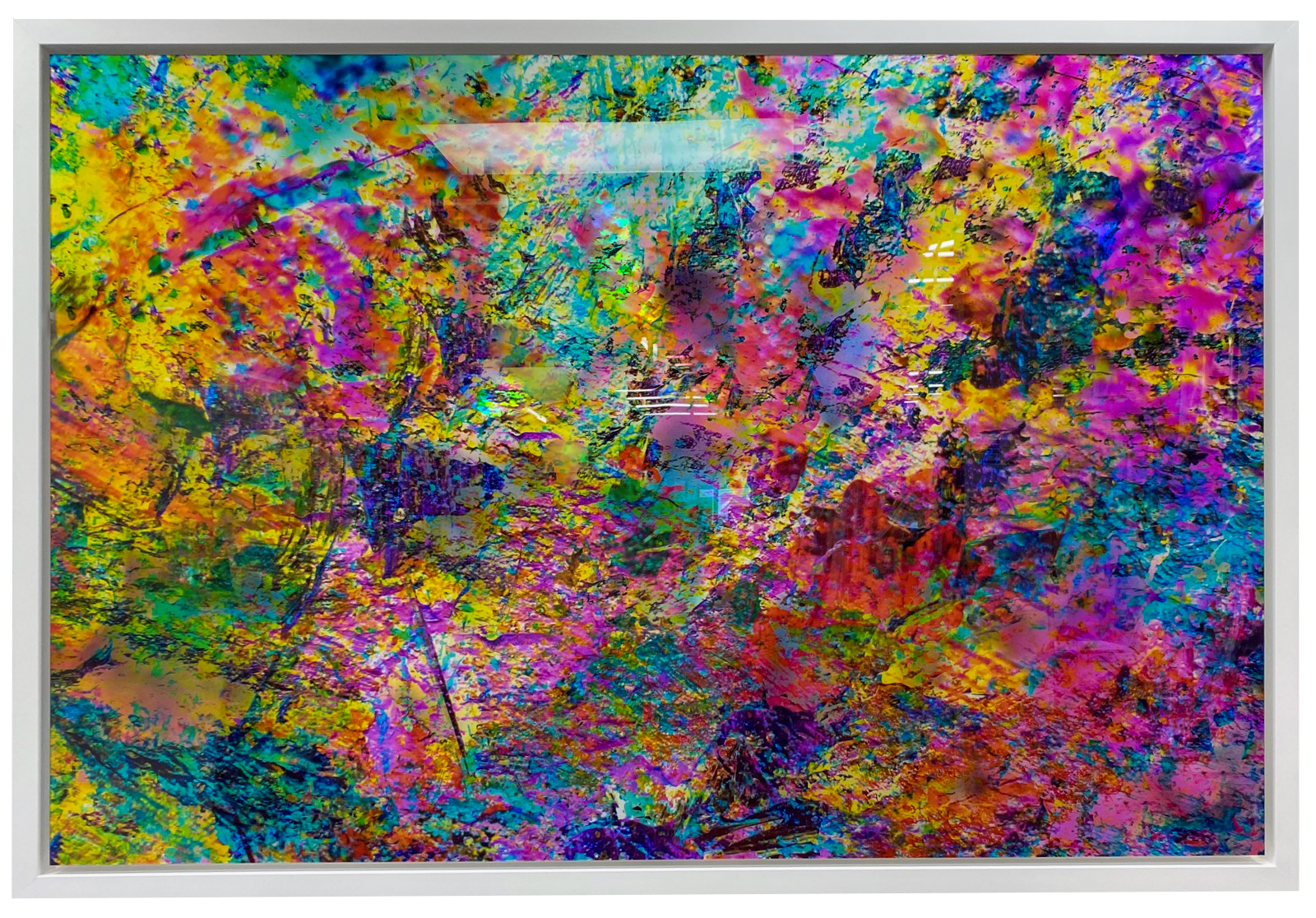
Geomorphology, 2014/2020
Chromogenic print (FujiFlex) mounted to Dibond (composed in-camera from multiple painted surfaces; no digital post-production)
50 × 70 in (127 × 177.8 cm)
Geomorphology, 2014/2020, presents a bird’s-eye view of a digitally mediated world, where the real and the virtual become increasingly difficult to separate. This new landscape is realized as a fantastical, topographical photocollage that ultimately resides as a photograph. Gestures are first made with oil and acrylic paint on wood panels. Through iterative photographic processes and chance, the composition emerges. The camera sensor and chip intervene as new agents of gesture, imprinting their inherent characteristics onto the image. Although photography traditionally offers a flat, smooth surface lacking the facture of painting, here, through experimentation and time, layers of paint and photography merge into a newly imagined terrain.
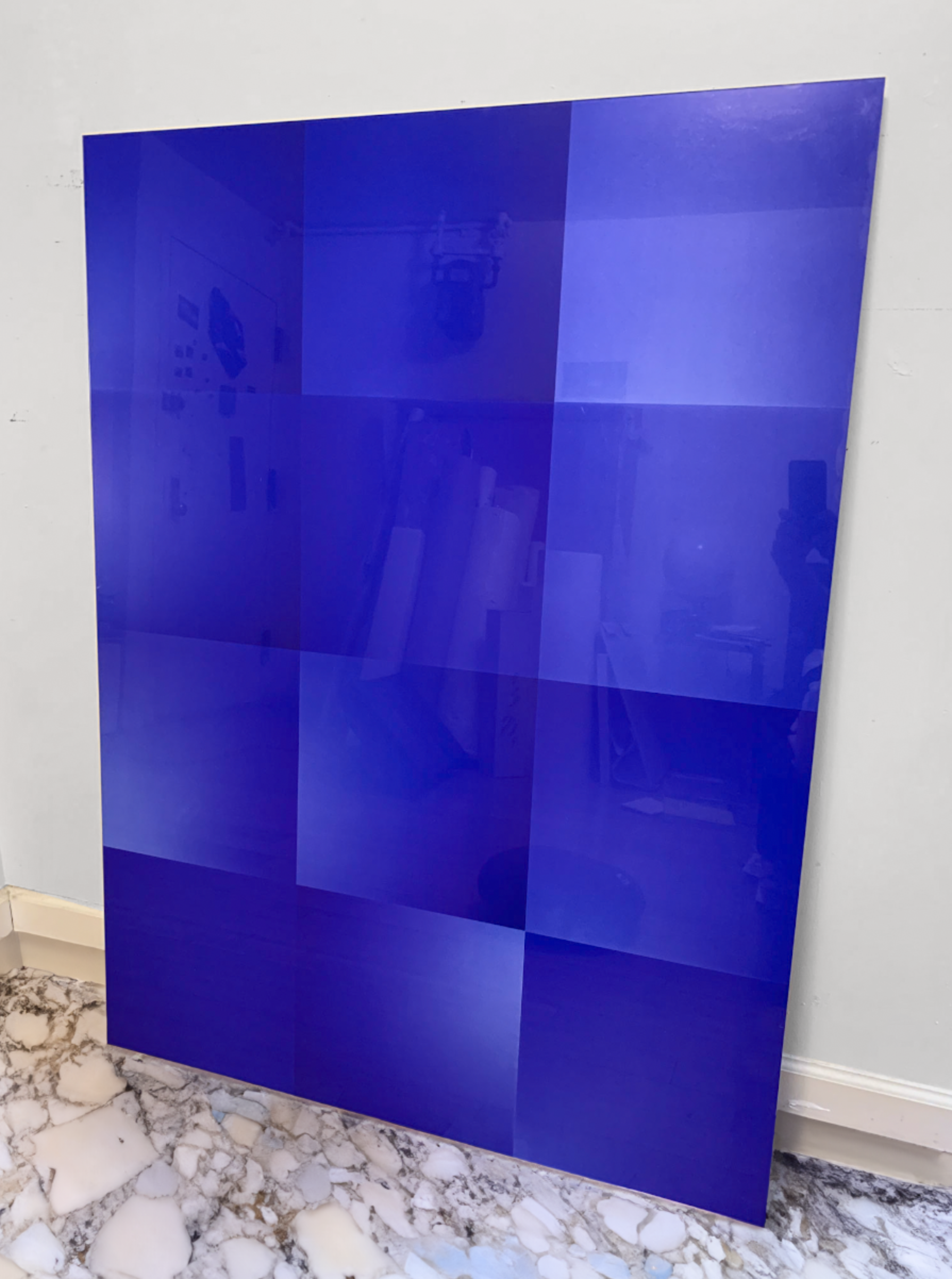
Memories of the Future, 2014/2020
Mixed-media sculpture, high-polish surface (reflections integral to the work)
48 × 36.5 in (121.9 × 92.7 cm); depth variable
A single exposed roll of medium-format film is transformed into sculptural form, reimagining the fundamental unit of time-based image-making—the film frame—as a brick. These luminous blocks, filled only with sky and light, are scanned, printed, and presented as they are on film: a grid-like composition that functions as both wall and memory structure.
The blue square, a recurring motif, serves as a symbol of indexicality—the foundation of photography’s “truth claim.” Echoing the logic of the interferometer, a scientific array that stitches fragments of data into one global image, the work envisions coherence through simultaneity. Truth here remains unstable, yet the gradients it leaves behind form a hypnotic and stable architecture.


Montage, 2021
Triptych, ultraviolet ink on cast Plexiglas with custom stainless-steel hardware
Each panel: 28 × 18.6 × 1.5 in (71.1 × 42.2 × 3.8 cm)
Total weight 105 lb (35 lb per panel)
Exhibited at Art Basel | Miami, Untitled Art, Miami, FL
Montage, 2021, explores the accelerating dematerialization and entropy of images and image-making. In an expanded approach to mark-making, the forms are generated through physical movements of red, green, and blue light sources—around an exposed digital camera sensor—from varied spatial positions and distances.
The resulting magenta and blue fragments are not digitally composed but arise through optical interaction. Each form is a self-reflexive shadow contour: the internal and external structure of the camera body casting itself back onto the sensor. Red, green, and blue were chosen for their role as the additive primaries of light.
The object dimensions correspond to standard digital photographs, rotated vertically to emphasize their physicality. This reorientation encourages the viewer to perceive them as objects rather than images. Their thickness was selected to heighten each site’s perceptual interaction, and the gap between object and wall directly affects the saturation via affecting the opacity of the object.
The work is tangentially inspired by the Double Slit Experiment—the foundational quantum physics trial that revealed light’s dual nature as both particle and wave. That paradox of image and event is echoed here: the pieces function simultaneously as traces and phenomena.
Finally, the work reflects a multi-generational legacyin real estate and construction. Reoriented horizontally and stacked, the forms resemble bricks; vertically aligned, they become windows. Mounted edge to edge, they form a wall. Their meaning shifts with physical arrangement, just as their formation emerged from the spatial choreography of light and body.